Why Most AI-Built Websites Don't Rank
Facts checked against sources
Short answer
Most AI-built websites don't rank for two reasons. First, sameness: most are built with the same few AI tools, so they share phrasing, structure and patterns, and pages that say what thousands of others say give search engines no reason to prefer them. Second, drift: as you keep revising, the AI quietly loses track of the details that decide rankings. Fixing both takes a human-led process that re-checks every step.
Picture a roofing contractor who prompts an AI site builder on a Saturday morning. By lunch there's a homepage, six service pages, a page for each of twelve nearby towns and ten blog posts. It reads well and looks professional.
Six months later, Search Console shows a trickle of impressions, mostly for the company's own name. The town pages don't appear for anything, and no AI assistant mentions the business.
That outcome is common, and it isn't bad luck. Once a technical cause is ruled out, there are two reasons it happens, and both get worse the more people use the same tools. This guide explains both, what Google's rules actually say, and the process that fixes it.
Is your site even indexed, with content in the HTML?
Rule this out first, because no content strategy helps a page Google can't read. Some AI-built sites don't rank for a simple reason: Google hasn't indexed them, or it indexed an empty shell.
The second case is common with AI app builders that output client-side rendered React apps. The HTML that arrives first can contain almost no text, and the page only fills in after JavaScript runs. Google's JavaScript SEO basics say rendering happens in a queue and content missing from the rendered HTML can't be indexed. Google still recommends server-side rendering or pre-rendering.
- Page indexing report
- URL Inspection on key pages
- Read the rendered HTML
- View page source
If Search Console shows your pages as excluded, or your headings and copy are missing from the HTML, fix that before anything below. Gate zero of our AI-built website audit walks through each check, including the Lovable, Wix and Framer specifics.
Does Google penalize AI-written content?
Google does not penalize content for being AI-written. Google's guidance on generative AI content says AI can help with research and structure. The same page warns that using it to produce many pages without adding value for users may breach the scaled content abuse policy.
So the test is value. Google's spam policies describe scaled content abuse as large amounts of unoriginal content that gives users little or no value, and list mass AI generation as one example. Our guides to Google's policy on AI-generated content and scaled content abuse cover the details.
That framing explains the real problem. Most AI-built sites don't get flagged for spam. They just never offer anything a search engine would prefer over the thousand similar pages already indexed.
Why do AI-built sites all look the same?
AI-built sites look the same because almost all of them come from a handful of AI models and site builders, each with favorite phrases, page structures and ways of answering a question.
Ask any of them for a homepage for a lender, a roofer or a law firm and you'll see the same moves: a "trusted partner" headline, three benefit cards, a "how it works" section with three steps, and a closing call to action.
You can change the colors, rewrite the headline and add your own touch. Underneath, the page usually still shares more with thousands of other sites than you'd expect: the same sentence rhythms, the same order of ideas, the same generic claims nobody could disagree with.
At Build Your Own Audience we call this sameness: a page that shares more with other AI-built pages than with the business it describes. It's the first reason AI-built sites don't rank.
Search engines and AI answer engines are built to find the best answer to a question. When a thousand pages say the same thing the same way, none of them is the best answer.
The page that wins has something the others don't. You can test your own copy with our AI sameness checker.
- Does your homepage say anything specific about how you work that a competitor's doesn't?
- Does any page contain a number, example or opinion only your business could supply?
- Do your service pages differ in substance, or only in the service name?
- Would a customer learn something on your site they couldn't learn on the first result?
Why does an AI-built site get worse as you revise it?
The second problem is less obvious, and it's the one that wastes the most time. At Build Your Own Audience we call it drift.
When you work on a site with AI, you revise: make this section stronger, add a page, change the offer. Each request gets handled well on its own. But the AI optimizes for the request in front of it, not the plan you started with.
Somewhere along the way the priorities shift. A heading structure that was right gets flattened.
A page that answered a specific search question gets rewritten into general marketing copy. Technical details that were correct on Tuesday are wrong by Friday, and nothing on the screen tells you.
What you asked for
- "Make the intro punchier"
- "Add a page for our new service"
- "Update the phone number"
What can quietly change
- The plain answer the page led with is gone
- A new page duplicates an old one's topic
- Structured data still shows the old number
Nothing on screen tells you the page has stopped doing its job. Our guide on why AI rewrites what you fixed covers what drifts first and how to catch it.
Why does the site feel nearly done when it isn't?
An AI-built site feels nearly done because the first pass gets everything you can see right and leaves most of what you can't. Together, sameness and drift create what we at Build Your Own Audience call the 80% illusion: a site that looks nearly done when it's about half done.
That's our framing from experience, not a measured statistic. The missing half is mostly structure, facts and code, which is why the site looks finished long before it is. The 80% illusion breaks down what that half contains.
What actually fixes an AI-built site?
The fix is a process with a person in charge of it. Three things matter most.
Start from substance only you have
The surest way out of sameness is content no model could have produced without you: your real process, your numbers, your customers' actual questions, your opinions about your industry. AI is excellent at shaping that material, but it can't invent it.
Our guide to original content with AI shows how to collect it.
Build in gates, in order
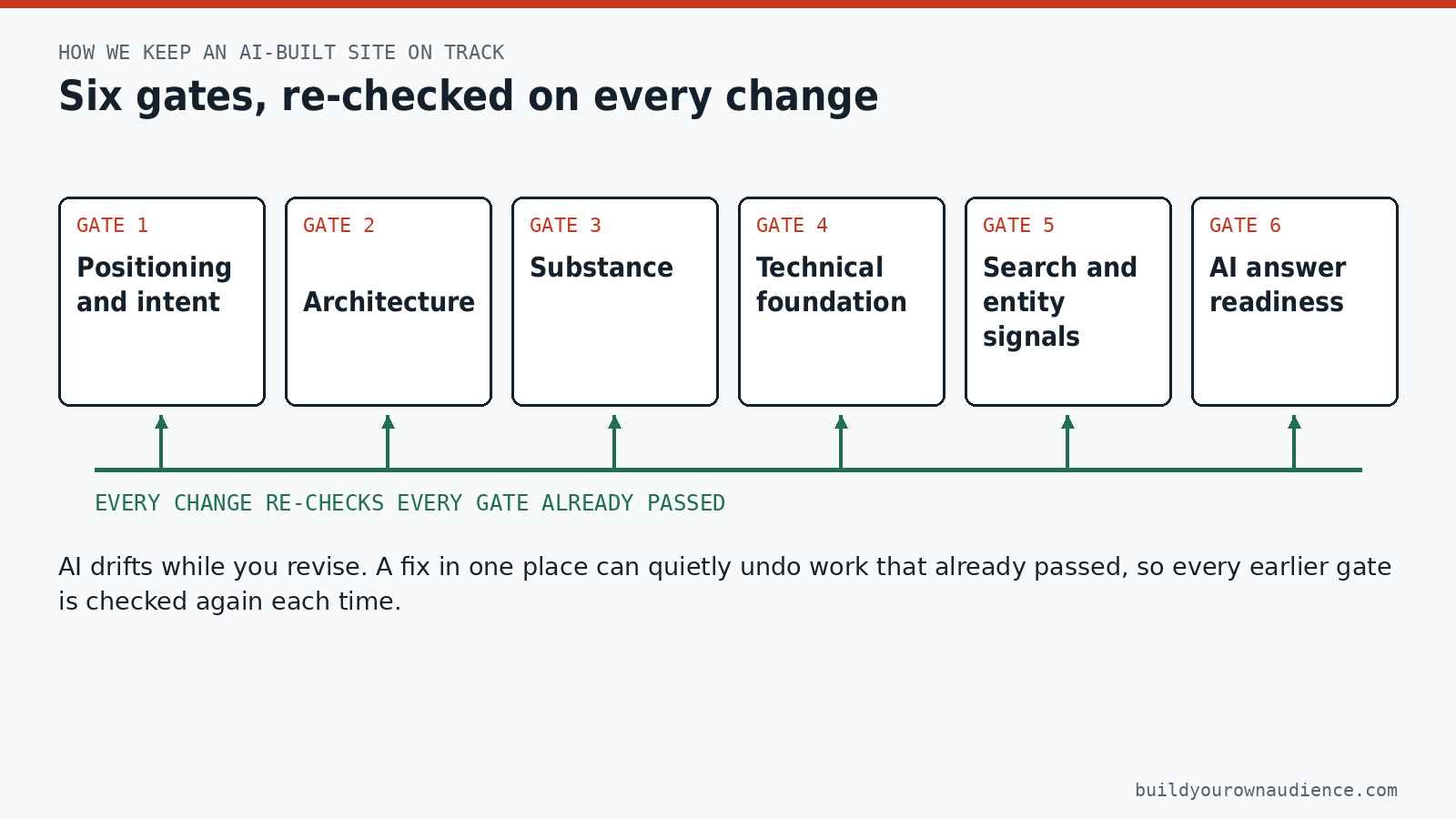
Build Your Own Audience's six-gate process puts every site through these gates, in this order:
- Positioning and intent. Who the site is for, and which questions each page must answer.
- Architecture. How pages connect, with one clear topic per page and no near-duplicates.
- Substance. Whether each page says something new and true about this business.
- Technical foundation. Crawlable, fast, valid code and a sitemap.
- Search and entity signals. Structured data that matches the visible page, and consistent business details.
- AI answer readiness. Plain, quotable answers near the top, and crawler access for AI search bots.
Nothing moves to the next gate until it passes the current one. The full checklist for each gate is in how to audit an AI-built website.
Re-check everything, every time
Because AI drifts, a gate that passed last week can fail this week. Every time a new step is cleared, every earlier step gets re-audited too. A copy edit on one page can remove the link another page depended on, or leave its structured data describing text that's gone.
What about location and service pages?
Location and service pages are where AI sameness does the most damage. Generating one page per city with the name swapped is fast, and Google's spam policies name exactly that pattern as doorway abuse.
Each location page needs facts that are true only there. See location pages without doorway pages.
What to do next
Run your homepage and one service page through the sameness checker. Then work through the six gates above, in order, and re-check the earlier ones every time you change something.
That's the process we use, and it's the process this website was built with. You can watch it work on our public scoreboard.
Common questions
Why isn't my AI-built website ranking?
Usually for one of three reasons. Google may not have indexed it, or sees an empty page because the content loads with JavaScript. If it is indexed, the pages probably say what thousands of other AI-built pages say, or later AI edits quietly broke what earlier fixes got right.
Can an AI-built website rank on Google?
Yes. Google's position is that it judges content on quality and usefulness, not on whether AI helped write it. The problem is that most AI-built sites end up generic and inconsistent, and generic, inconsistent sites rarely rank no matter who made them.
Why does my AI website look good but get no traffic?
Looking good and ranking well depend on different things. Search engines and AI assistants look for original substance, clear structure, consistent technical signals and evidence that a real business stands behind the site. AI tools are good at the look and unreliable at the rest.
How do I make an AI-built site stand out?
Start from what only your business knows: your real process, your data, your customers' actual questions and your opinions. Then have a person check every page against a standard for structure, technical health and originality, and re-check earlier pages whenever later changes are made.
What should I fix first if my AI-built site isn't ranking?
Start with indexing: confirm in Search Console that Google has indexed your pages and that your text is in the HTML, not loaded later by JavaScript. Then fix sameness by adding substance only your business has. Then stop drift by re-checking every page after each change.